






Introduction
Decades of dependence on synthetic fertilizers, pesticides, and costly external inputs have delivered short-term productivity gains but have also degraded soil health, depleted groundwater, and left farmer incomes stagnant despite rising cultivation costs. Natural farming has emerged as a widely discussed alternative—a chemical-free, low-cost, ecologically grounded system that seeks to restore the biological vitality of the soil while reducing farmers’ dependence on purchased inputs.
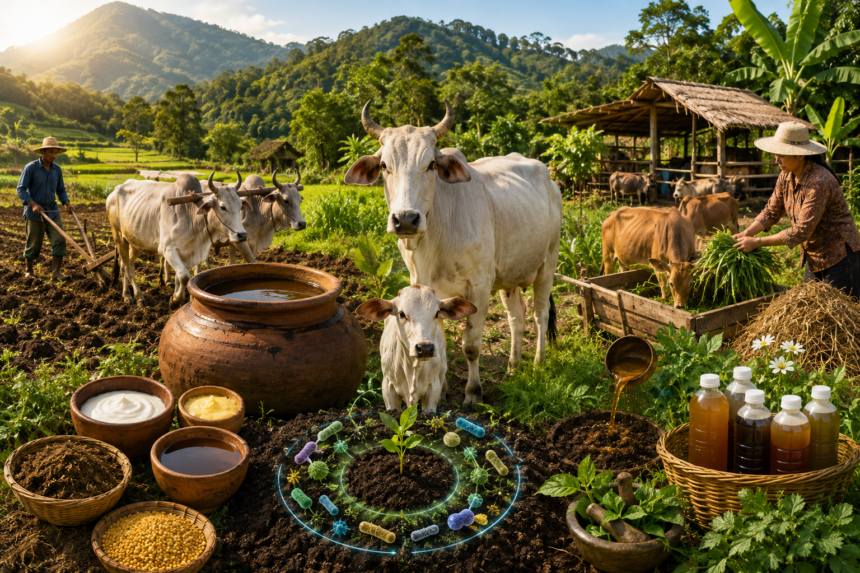
What distinguishes natural farming from many other alternative agricultural movements is the central role it assigns to livestock. Far from being a peripheral enterprise conducted alongside crop cultivation, animal rearing functions as the engine that drives the entire system. Cattle supply dung, urine, and other biological materials from which key natural farming inputs—including Jeevamrit, Beejamrit, and Ghanjeevamrit—are prepared. This article examines the roles livestock perform within natural farming, including their biological function in soil regeneration, contribution to farm operations and household economics, the importance of indigenous cattle breeds, the supporting policy architecture, and the constraints limiting wider adoption.
Conceptual Framework: Livestock at the Centre of Natural Farming
Natural farming is generally described as a diversified, agroecology-based system that integrates crops, trees, and livestock and is commonly associated with four major principles: cow dung- and urine-based inputs such as Panchagavya, Beejamrit, Jeevamrit, and Ghanjeevamrit; intercropping; mulching; and Whapasa, or limited soil-moisture management.
The underlying premise is that a properly functioning agroecosystem does not require large quantities of purchased fertilizers. Plants derive most of their carbon and energy from air, water, and sunlight, while soil biological processes make nutrients available to plants. Livestock contribute organic matter and microbial resources that support this biological cycle. In a livestock-integrated system, the farm can generate many of its principal soil inputs on-site rather than importing compost or biofertilizers from outside. At the same time, animals provide milk, manure, and, where applicable, draught power, thereby helping create a circular production system in which biological resources are continually recycled within the farm.
The Biological Basis: Livestock-Derived Bioformulations
Livestock-derived bioformulations are natural inputs prepared from cattle by-products such as dung, urine, milk, curd, and ghee. These formulations are used in cow-based natural farming (CBNF) as biofertilizers, biopesticides, seed treatments, and plant-growth promoters. Key formulations include Panchagavya, Jeevamrit, and Beejamrit, while botanical preparations such as Neemastra and Dashaparni Ark are also used in natural farming practices.
Panchagavya, prepared from five cow-derived ingredients—dung, urine, milk, curd, and ghee—is traditionally fermented and used as a plant-growth promoter. Scientific investigations have increasingly examined its microbial and biochemical composition. Metagenomic studies have helped characterise its bacterial communities and identify microorganisms potentially associated with plant-growth promotion and induced systemic resistance. Research using 16S rRNA amplicon sequencing has identified taxa belonging to groups such as Streptomyces, Clostridiales, Bacteroidales, and Verrucomicrobia. Functional analyses have also indicated the presence of metabolic pathways associated with carbohydrate metabolism and secondary-metabolite production.
Fermentation duration can influence the biological properties of these preparations. Comparative studies have reported differences in nutrient concentrations, microbial populations, and indole-3-acetic acid (IAA) content among Panchagavya, Jeevamrit, and Beejamrit. Such findings are relevant to the development of quality standards and shelf-life protocols if these formulations are to be produced at an entrepreneurial or commercial scale.
Beejamrit is a seed-treatment formulation generally prepared using cow dung, cow urine, and soil, often with lime or limestone. Traditionally, seeds are treated or soaked with the preparation before sowing. Field and laboratory studies have reported that applications of Jeevamrit and Beejamrit can improve soil biological activity and plant development, potentially reducing dependence on purchased agrochemicals and improving the economic returns from cultivation.
Jeevamrit is often regarded as one of the most important inputs in natural farming. It is prepared by fermenting cattle dung and urine with jaggery, pulse flour, and a small quantity of soil, which serves as a source of native microorganisms. Studies of natural farming systems have reported improvements in soil organic carbon and the availability of nutrients such as phosphorus and potassium following repeated application of organic and microbial inputs. Changes in soil microbial communities, including increased representation of bacteria involved in nutrient cycling, have also been documented.
Ghanjeevamrit is a concentrated, semi-solid form of a Jeevamrit-type preparation. Recent multi-omics research has examined the microbial and metabolite profiles of Jeevamrit and Ghanjeevamrit, identifying diverse microbial communities and numerous metabolites associated with nutrient cycling and plant-growth promotion. Comparative research involving different cattle breeds has also reported variation in the nutrient composition and microbial populations of cattle-derived formulations. In some studies, preparations derived from indigenous cattle breeds have recorded higher concentrations of nitrogen, phosphorus, and potassium and greater microbial abundance than those derived from other breeds. Related microbiological research has identified isolates capable of phosphate solubilisation and suppression of important soil-borne fungal pathogens.
Together, these findings suggest that some of the benefits traditionally attributed to cattle-based inputs may be associated with identifiable microbial and biochemical mechanisms. However, the strength and consistency of these effects can vary with preparation methods, environmental conditions, cattle breed, fermentation duration, and field management practices.
Functionally, Beejamrit is primarily used to protect seeds and support early seedling establishment; Jeevamrit and Ghanjeevamrit are applied during crop growth to stimulate soil microbial activity and nutrient cycling; and mulching complements these practices by conserving soil moisture, moderating soil temperature, and reducing erosion.
Soil Health, Nutrient Cycling, and Crop Performance
Continuous, low-volume application of dung- and urine-based inputs introduces organic matter and microbial populations into the soil on a recurring basis. This differs from the periodic application of bulk quantities of composted manure or synthetic fertilizers.
The agronomic evidence, however, is more nuanced than some early claims suggested. Studies have reported variable yield outcomes under natural farming, with results differing according to crop, soil type, climate, management practices, and duration of adoption. Some research has recorded yield reductions compared with conventional farming, while other studies have reported comparable yields under particular conditions.
Importantly, the economic performance of natural farming can be strongly influenced by access to livestock. Farmers who own cattle and can prepare inputs on-farm may achieve greater savings by avoiding the purchase of fertilizers and other external inputs. Thus, the economic case for natural farming is closely connected not only to agronomic performance but also to the availability of livestock and the ability of farmers to integrate crop and animal production.
Draught Power and Household Economics
Beyond their role in biofertilizer preparation, livestock retain their traditional operational importance, particularly in hill and rainfed farming systems where mechanisation may be constrained by terrain, small landholdings, or high machinery costs.
Draught cattle can perform tillage, transportation, and other farm operations, reducing dependence on diesel-powered machinery. This operational role complements their contribution to soil fertility. The same animal that supplies dung and urine for preparing Jeevamrit may also assist in field operations, while crop residues and fodder by-products can be returned to the animal as feed. Manure can subsequently be returned to the soil, helping close the nutrient cycle at the household level.
Milk and milk products provide an additional source of household income that is relatively independent of the crop production cycle. Integrated crop-livestock systems can therefore provide greater livelihood resilience than crop-only systems by diversifying both production and income sources.
Indigenous Cattle Breeds: The Preferred Biological Engine
A consistent theme in natural farming literature and official guidance is the preference for indigenous or Desi cattle as a source of dung and urine. Advocates of cow-based natural farming argue that indigenous cattle are particularly suited to the system because of their adaptation to local climatic and management conditions and the biological characteristics of their manure and urine.
This has particular relevance for the Northeast Hill states, where locally adapted cattle populations—including Thutho cattle in Nagaland, Manipuri cattle in Manipur, Zobawng cattle in Mizoram, Siri cattle in Sikkim, Masilum cattle in Meghalaya, and Balang cattle in Arunachal Pradesh—have historically been maintained by tribal and smallholder communities under low-input management systems.
These cattle populations represent both important genetic resources for conservation and potentially valuable biological resources for natural farming. Integrating indigenous cattle conservation with the promotion of cow-based natural farming could therefore serve a dual purpose: safeguarding livestock genetic diversity while strengthening the regional resource base for low-external-input agriculture.
Policy Architecture
In November 2024, the Union Cabinet approved the National Mission on Natural Farming (NMNF) as a standalone Centrally Sponsored Scheme under the Ministry of Agriculture and Farmers’ Welfare, with an outlay of ₹2,481 crore. The mission aims to support natural farming among farmers through cluster-based implementation, demonstrations, capacity building, and bio-input resource centres. Training programmes include the preparation and application of natural farming inputs such as Beejamrit and Jeevamrit.
Running alongside the NMNF, the Rashtriya Gokul Mission focuses on the conservation, development, and genetic improvement of indigenous cattle breeds through scientific breeding and management. The mission also supports Gokul Grams as integrated indigenous cattle development and conservation centres.
Together, these initiatives provide a two-pronged policy framework: the NMNF promotes farmers’ capacity to adopt natural farming practices and prepare biological inputs, while the Rashtriya Gokul Mission strengthens the conservation and development of indigenous cattle populations on which cow-based systems may depend. This convergence is particularly relevant to institutions involved in indigenous cattle conservation and CBNF promotion at the state and district levels.
Constraints and Challenges
Livestock-integrated natural farming also faces several practical constraints. Dependence on livestock can itself become a limitation for households that do not own adequate numbers of cattle. Government assessments have recognised that cow-based input systems can be difficult to sustain in areas where cattle rearing is not traditionally practised.
The approach is also knowledge-intensive. Farmers require sustained training because the preparation, timing, storage, dilution, and application of bioformulations require practical and technical understanding. Weak extension and training systems can lead to inconsistent preparation quality and variable field performance.
Scientific standardisation is another emerging challenge. Although research on the microbiome and metabolome of natural farming inputs is expanding, systematic characterisation remains limited. Comparisons between standardised laboratory preparations and farmer-prepared formulations are still relatively scarce, even though variations in ingredients, fermentation conditions, storage, and application methods can influence performance.
Finally, agronomic evidence on yield outcomes remains mixed rather than uniformly positive. This highlights the importance of locally calibrated research and long-term field trials before recommending natural farming practices across diverse agroecological regions. What works effectively in one crop, soil type, or climatic zone may not necessarily produce the same results elsewhere.
Conclusion
Livestock occupy a position in natural farming that can aptly be described as that of a living engine. They supply the raw materials for Beejamrit, Jeevamrit, Ghanjeevamrit, and other formulations whose microbial and biochemical properties are increasingly being investigated. These preparations may contribute to nutrient cycling, soil biological activity, plant growth, and suppression of certain soil-borne pathogens.
Livestock also continue to provide draught power where mechanisation is limited and diversify household income through milk and other livestock products. Indigenous cattle breeds may be particularly valuable because of their adaptation to local production environments. In the Northeast Hill states, cattle populations such as Thutho, Manipuri, Zobawng, Siri, Masilum, and Balang represent both conservation priorities and potentially important biological resources for promoting low-external-input and natural farming systems.
National policy, particularly through the National Mission on Natural Farming and the Rashtriya Gokul Mission, has begun to support this convergence between natural farming and indigenous livestock development. Realising its full potential, however, will require sustained attention to uneven livestock access, the knowledge-intensive nature of bioformulation preparation, scientific standardisation, quality control, and the need for locally calibrated agronomic evidence.
Ultimately, the success of livestock-integrated natural farming will depend not simply on placing cattle at the centre of the farm, but on building a genuinely integrated ecosystem in which livestock, soil, crops, biodiversity, and farmers’ livelihoods reinforce one another. In this sense, livestock are not merely an input source; they are a critical component of a circular farm economy and of the broader vision of “One Farm, One Ecosystem and One Health.”
This article is written by Dr. Zeshmarani Sarangthem, Professor & Head, Department of Livestock Production Management, and Dr. Imtiwati, Assistant Professor (SS), Department of Livestock Production Management, College of Veterinary Sciences & Animal Husbandry, Jalukie, Peren District, Nagaland, India, for publication on the occasion of the forthcoming three-day National Conference on “Natural Farming: Pathways to Self-Reliant Farming and Rural Prosperity,” with the motto “One Farm, One Ecosystem and One Health,” to be held from 9–11 September 2026 under the aegis of Central Agricultural University (Imphal), Manipur, at the College of Post Graduate Studies in Agricultural Sciences (CPGSAS), Umiam, Meghalaya.