




From a Rs. 3,500 Film to International Festivals: Ploto Debbarma Takes Tripura’s Cinema Beyond Borders
Agartala, September 1, 2026: From borrowing a friend’s camera to make a film on a budget of just Rs. 3,500 to taking a Kokborok feature to international film festivals, the journey of Ploto Debbarma, an independent filmmaker from Agartala, Tripura, reflects the determination and resourcefulness behind the state’s emerging independent cinema.
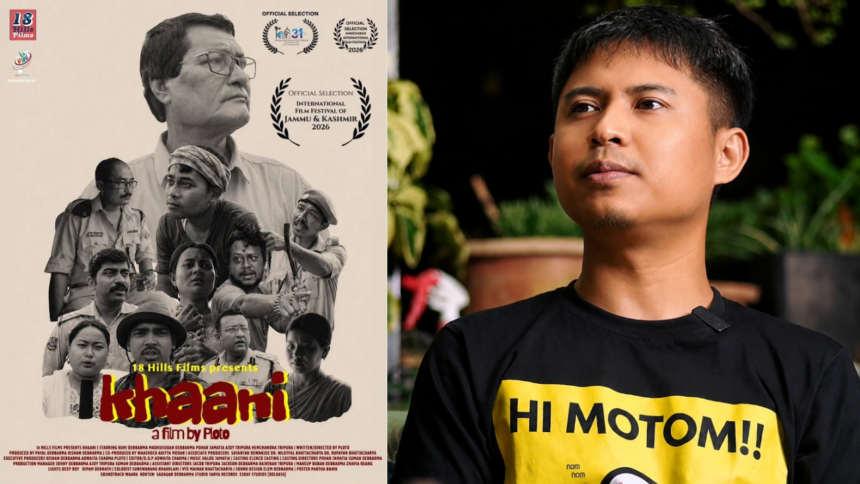
Ploto’s latest film, “KHAANI,” written and directed by him and presented by 18 Hills Films, has been officially selected for the 1st International Film Festival of Jammu & Kashmir (IFFJK) 2026.
The inaugural festival is scheduled to be held from September 7 to September 10, 2026. According to the official IFFJK website, the event is being organised by the Directorate of Information and Public Relations (DIPR), Union Territory of Jammu & Kashmir, under the theme “Rang-e-Cinema.”
The festival aims to create a platform for artistic excellence, cinematic innovation and cultural exchange, bringing filmmakers and audiences together from different parts of India and around the world.
Its programme includes an international competition, curated showcases and dedicated sections for feature films, documentaries, short films and regional cinema, including J&K Select and Bharat Panorama.
For KHAANI, the selection adds another significant chapter to its festival journey. According to 18 Hills Films, this is the third international festival selection for the film.
A Journey That Started With Rs. 3,500
Long before KHAANI began travelling to major festival platforms, Ploto Debbarma was experimenting with filmmaking using extremely limited resources.
His short film “Graveyard of Dreams” won two awards at the Book Toux Northeast Film Festival 2023, establishing an early milestone in his independent filmmaking career.
What makes the achievement particularly striking is the scale of the production. The film was made with a budget of only Rs. 3,500, while Ploto borrowed a friend’s camera to shoot it.
Reflecting on his filmmaking journey, Ploto said:
“A Rs. 3,500 budget and borrowing a friend’s camera for an award winning film. Working with the equivalent of pocket money is familiar.”
That experience captures the reality of independent filmmaking that has shaped his career—creating stories with whatever resources are available and gradually building recognition through festival platforms.
From Medicine to Movies
Ploto Debbarma’s professional background is far removed from conventional film-school training. He is a graduate of Rajiv Gandhi Memorial Ayurvedic College and initially began his career as a physician.
His interest in cinema, however, eventually led him towards filmmaking. He was informally mentored by filmmaker Debarati Gupta, gaining practical knowledge of the craft through hands-on experience.
Before making KHAANI, Ploto created several short films, including Graviva of Dreams, Love and Achar, and Samthiyo Family. These works were featured at festivals across Brahmaputra, Manipur and Mumbai.
His transition from small-budget short films to a full-length feature has now taken his work to increasingly prominent platforms.
KHAANI: A Kokborok Story Rooted in Tripura
KHAANI is a Kokborok feature film written and directed by Ploto Debbarma and presented by 18 Hills Films.
The film features Ruhi Debbarma, Madhusudan Debbarma, Pohar Jamatia, Ajoy Tripura and Hemchandra Tripura, among others.
Set in the fictional village of Khumpuimora, KHAANI is a comedy-thriller centred around the Tiprasa tribal community. The story develops around a deserted police station and a mysterious discovery of human remains.
The film was shot entirely in Tripura, with locations spread across South-West Tripura, Sepahijala and Gomati.
Making a feature film in Tripura also came with its own technical and infrastructural challenges. Despite these limitations, Ploto completed KHAANI on a modest budget of Rs. 1-10 lakh. Post-production support was provided by filmmaker Monet Roy Saha in Kolkata.
The KIFF Breakthrough
Before its latest IFFJK selection, KHAANI had already achieved a significant milestone at the 31st Kolkata International Film Festival (KIFF).
The film was selected alongside another Tripura feature, “Porobashi,” directed by filmmaker Monet Roy Saha. The dual selection placed two full-length feature films from Tripura on the programme of one of India’s prominent film festivals.
Porobashi was scheduled for screening at Nandan 2 on November 7, 2025, under the Linguistic Diversity category.
KHAANI was scheduled to be screened on November 8, 2025, at Prachi Cinema, under the Unheard India: Rare Language Films section. A second screening was scheduled for November 9, 2025, at Rabindra Bhavan.
The appearance of both films at KIFF highlighted the growing visibility of Tripura’s filmmakers and the increasing space for regional and rare-language cinema on national platforms.
Two Filmmakers, Two Very Different Journeys
While Ploto Debbarma built his filmmaking career through independent work and limited resources, Monet Roy Saha entered cinema through a strong background in visual arts.
Monet is a graduate of the Pune Film Institute and previously served as faculty at Delhi University’s College of Art. His artistic journey began in the sculpture department of Rabindra Bharati University.
The son of renowned sculptors Bipul Kanti Saha and Dipika Saha, Monet eventually transitioned from sculpture to filmmaking and earned recognition for his short films and advertising work, including a tourism film made for Japan.
His feature film Porobashi is a 108-minute serious drama about a retired schoolteacher who migrated from Bangladesh to Tripura in 1965.
The film explores the character’s emotional isolation before leading him towards the borderlands in a story shaped by loss and unresolved identity.
Porobashi was shot partly in Tripura and at Kamarpukur in West Bengal, with the locations helping portray the Indo-Bangladesh border. The film was produced by Anil Chandra Debnath.
Different Paths, Similar Roots
The journeys of Ploto Debbarma and Monet Roy Saha are different, but their films share a common foundation—the landscape, people, culture and linguistic identity of Tripura.
KHAANI was filmed entirely within Tripura, while Porobashi also uses the state as a significant part of its story and visual setting.
For Ploto, the road from Graveyard of Dreams to KHAANI demonstrates how independent filmmaking can grow from extremely modest beginnings. The Rs. 3,500 short film that relied on a borrowed camera eventually led to a feature-length Kokborok production appearing at major festival platforms.
Ploto had earlier summed up the unexpected scale of his festival journey by saying:
“It feels like I was playing cricket in my neighborhood and suddenly found myself at Lord’s.”
For Monet Roy Saha, Porobashi carries a different message, which he described as “a tribute to those who remain unseen and unacknowledged in the folds of history.”
Tripura’s Cinema Steps Into a Wider Spotlight
The growing festival journey of KHAANI, together with the recognition received by Porobashi, points to a wider development in Tripura’s independent film scene.
Both productions bring locally rooted stories and regional identities to audiences outside the state, while KHAANI adds the representation of Kokborok-language cinema to that expanding presence.
The KHAANI team has expressed gratitude to its cast, crew and producers for supporting the film and helping it reach successive festival platforms.
Now, with its official selection at the 1st International Film Festival of Jammu & Kashmir 2026, KHAANI is set to begin another chapter of its journey.
For Ploto Debbarma, the path from an award-winning Rs. 3,500 short film to an internationally selected feature film is also a reminder of how far Tripura’s independent filmmakers can travel even when the journey begins with little more than a borrowed camera, limited resources and a story they believe deserves to be told.