





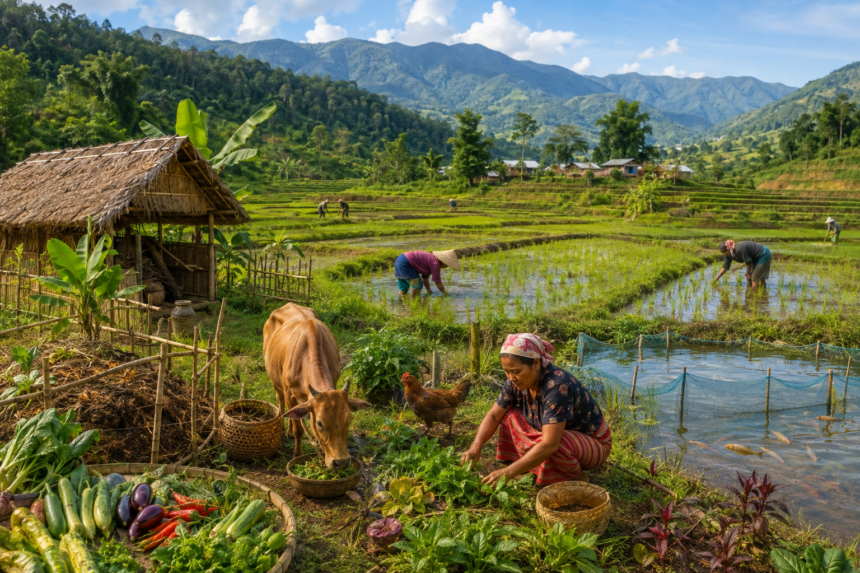
Agriculture has always been closely linked with the cultural, ecological and economic life of Manipur. The geographical setting of the state, characterized by a central valley surrounded by hills, forests, wetlands and diverse agro-climatic environments, has encouraged the development of varied agricultural systems. Rice occupies a central place in the agricultural landscape of Manipur, while shifting cultivation, terrace farming, horticulture and mixed farming have historically been practiced across different ecological zones.
Before the widespread adoption of synthetic fertilizers, pesticides, herbicides and other industrial agricultural inputs, farming depended primarily on ecological processes and locally available resources. Soil fertility was maintained through the recycling of organic materials, crop residues, animal manure, forest biomass and decomposed vegetation. Farmers also relied on locally adapted crop varieties, seasonal knowledge and diversified production systems.
Modern natural farming and agroecology emphasize ecological interactions among soil, plants, animals, microorganisms and humans. Important principles include biodiversity, recycling, resilience, efficiency, knowledge sharing and the integration of local knowledge with scientific innovation. Although the term “natural farming” is relatively modern, several of its principles were embedded in the traditional agricultural practices of Manipur.
Therefore, the study of ancient and indigenous agricultural traditions is important not merely as a historical exercise but also as a source of knowledge for developing sustainable, locally adapted and climate-resilient agricultural systems.
Agriculture and Ecological Wisdom in Traditional Manipur
Traditional agricultural systems in Manipur evolved through long-term interactions between communities and their surrounding environment. Farmers observed rainfall patterns, soil characteristics, water availability, vegetation, insect activity and crop behaviour and used this accumulated knowledge in agricultural decision-making.
A systematic study of indigenous agricultural knowledge in Manipur has documented several traditional practices related to crop production, soil management, crop protection and poultry farming, highlighting the continuing importance of indigenous technical knowledge in the state.
Traditional farming systems were generally characterized by:
– Dependence on locally available natural resources;
– Limited dependence on externally purchased inputs;
– Recycling of crop and livestock residues;
– Cultivation of locally adapted crop varieties;
– Integration of crops, animals and, in some locations, fish;
– Soil and water conservation practices;
– Diversified production systems; and
– Community-based transmission of agricultural knowledge.
The agricultural systems of the valley and hills differed according to topography and ecology. Lowland and wetland rice cultivation dominated many parts of the valley, whereas terrace cultivation and shifting cultivation were historically important in the hill regions.
Traditional Paddy Cultivation and Indigenous Crop Diversity
Rice has historically been the principal staple crop of Manipur. Traditional rice cultivation depended on rainfall, local water resources, fertile soils and indigenous varieties adapted to different ecological conditions.
Farmers traditionally conserved and selected seeds suited to variations in soil, water and climate. The importance of indigenous rice diversity is clearly demonstrated among the Inpui community, a Naga community of Manipur, where a rich collection of traditional paddy varieties has been maintained for cultivation under shifting agricultural conditions. Traditional farmers also developed local methods for identifying, selecting and propagating desirable rice variants.
Modern agroecological approaches recognize biodiversity as an essential component of resilient food systems. Therefore, the conservation and scientific evaluation of indigenous rice varieties of Manipur can contribute to both agricultural sustainability and food security.
Livestock Integration and Nutrient Recycling
Nutrient recycling is a fundamental principle of natural farming. Traditional agricultural systems frequently maintained close linkages between crop production and livestock. Cattle, buffaloes, pigs and poultry contributed to household livelihoods and could also support nutrient recycling through manure and the utilization of crop residues.
Organic manure contributes to soil organic matter and can improve soil physical, chemical and biological properties. Recycling biodegradable farm materials reduces waste and supports circular nutrient flows within agricultural systems.
Integrated farming is also considered relevant to the agricultural development of Manipur. ICAR has identified farming systems involving rice, pig, fish and poultry as promising approaches for natural resource management and agricultural diversification in the state.
Home Gardens as Biodiversity-Based Production Systems
Traditional household gardens have long served as important sources of food, spices, fruits, medicinal plants and other useful biological resources. These gardens represent small but highly diversified production systems in which multiple plant species are maintained within limited spaces.
Agroecology places considerable importance on diversity, synergies and the use of locally adapted biological resources. Traditional home gardens of Manipur can therefore be considered relevant models for modern nutrition-sensitive and biodiversity-based natural farming.
Traditional Soil and Water Conservation
Soil and water conservation have always been important in the fragile hill ecosystems of Northeast India. Indigenous communities developed locally adapted practices for managing slopes, rainfall and soil erosion.
Traditional soil and water conservation techniques have been documented across Northeast India, including practices associated with hill agriculture and shifting cultivation. Such knowledge is especially important because soil erosion and land degradation remain major concerns in sloping agricultural landscapes.
Shifting Cultivation and Ecological Regeneration
Shifting cultivation, commonly known as jhum, has historically been practiced in the hill regions of Northeast India, including Manipur. The system involves cultivating a piece of land for a limited period, followed by a fallow phase during which vegetation regenerates.
The sustainability of shifting cultivation depends greatly on factors such as fallow duration, population pressure, land availability, slope management and the intensity of cultivation. Research on indigenous soil and water conservation emphasizes that shortening of jhum cycles can increase pressure on land and contribute to soil erosion and declining soil fertility.
Therefore, shifting cultivation should not be viewed as either entirely sustainable or entirely destructive. Its ecological effects are context-dependent. The major lesson for modern natural farming is the recognition that agricultural land requires biological regeneration.
Rice–Fish and Integrated Aquatic Farming Traditions
The close relationship between agriculture and aquatic ecosystems is particularly important in Manipur. Traditional rice–fish farming practices among indigenous communities demonstrate the potential for integrating food production systems.
A recent study of the Mao indigenous community documented traditional rice–fish farming in terrace fields and noted the coexistence of shifting cultivation and terrace-based agricultural systems in the region.
The revival and scientific improvement of traditional rice–fish systems can therefore form an important component of ecological and natural farming strategies in Manipur.
Plant-Based and Ecological Approaches to Crop Protection
Before commercial pesticides became widely available, farmers depended on practical ecological methods for protecting crops. These included observation, crop diversity, physical removal of pests and the use of locally available biological materials.
Indigenous agricultural knowledge documented in Manipur includes traditional practices associated with crop protection against birds, insects, pests and diseases.
Mixed Cropping and Agricultural Diversity
Traditional agriculture generally depended on diversity rather than complete specialization. Farmers cultivated cereals, pulses, vegetables, fruits, tubers, spices and other crops according to local ecological conditions.
The agroecological framework of the Food and Agriculture Organization recognizes diversity, recycling, resilience and synergies as key elements of sustainable agricultural systems.
Thus, traditional agricultural diversity in Manipur provides an important foundation for designing modern farming systems that combine productivity with ecological stability.
Indigenous Knowledge and Seasonal Agricultural Calendars
Traditional farmers developed detailed knowledge of local seasons and environmental indicators. Agricultural operations such as land preparation, sowing, transplanting, harvesting and storage were closely linked with rainfall, temperature and water availability.
Indigenous technical knowledge represents accumulated experience developed through repeated interaction with local ecosystems. Such knowledge remains valuable in the context of climate change, although changing rainfall and temperature patterns may require continuous adaptation.
Community, Culture and Agricultural Knowledge
Agriculture in traditional societies was not merely an economic activity. It was closely connected with culture, food traditions, community relationships and systems of knowledge transmission.
Modern agroecology also recognizes culture, human and social values, co-creation of knowledge and community participation as important elements of sustainable food systems.
Natural Farming and Contemporary Agricultural Challenges
Rising Input Costs:
The increasing cost of fertilizers, pesticides and other agricultural inputs can place significant economic pressure on farmers. Farming systems that enhance the use of locally available organic resources may reduce dependence on purchased inputs.
Soil Degradation:
Declining soil organic matter and soil health are major challenges in intensive agricultural systems. Practices such as mulching, composting, biomass recycling and integrated farming can contribute to improved soil functioning.
Climate Variability:
Diversified and locally adapted farming systems can increase resilience by reducing dependence on a single crop or production method.
Biodiversity Loss:
The replacement of indigenous crop varieties by a narrow range of commercial varieties can reduce agricultural genetic diversity. Traditional seed conservation practices in Manipur demonstrate the importance of local communities in maintaining crop diversity.
Food and Nutritional Security:
Natural farming should not focus exclusively on staple crop production. Diversified systems involving cereals, vegetables, fruits, pulses, livestock and fish can improve food availability and dietary diversity.
Role of Food Technology and Value Addition
The relevance of natural farming extends beyond crop production. Ecologically produced indigenous crops can be transformed into safe and value-added food products through appropriate food-processing technologies.
Traditional and natural farming systems can support the development of:
– Indigenous rice products;
– Fermented foods;
– Bamboo shoot products;
– Traditional pickles;
– Fruit and vegetable products;
– Herbal and plant-based products; and
– Functional foods based on indigenous crops.
Value addition can improve product shelf life, safety, convenience and marketability while creating economic incentives for conserving indigenous crops and traditional farming systems.
A Framework for Revitalizing Natural Farming in Manipur
A modern strategy for natural farming in Manipur may include the following components:
Documentation of Indigenous Knowledge:
Traditional agricultural practices, local crop varieties and ecological knowledge should be systematically documented and preserved.
Soil Health Restoration:
Composting, mulching, crop-residue recycling and biological soil management should receive greater emphasis.
Indigenous Seed Conservation:
Community seed banks and research-supported conservation programmes can protect local crop genetic resources.
Diversified Farming Systems:
Crop–livestock–fish–tree integration should be promoted according to local ecological conditions.
Scientific Validation:
Indigenous agricultural practices should be evaluated through laboratory experiments, field trials and participatory research.
Farmer Training:
Training programmes should combine traditional ecological knowledge with advances in soil science, crop management and climate adaptation.
Value Addition and Marketing:
Processing and branding of indigenous agricultural products can generate additional income and encourage biodiversity conservation.
Youth Engagement:
Young farmers, researchers and students should be encouraged to view indigenous agricultural knowledge as a source of innovation and entrepreneurship.
Conclusion
Natural farming in traditional Manipur was rooted in a close relationship between agriculture, ecology, culture and community. Although earlier farming communities did not use the modern terminology of “natural farming,” many of their practices reflected principles now recognized as central to agroecology, including biodiversity, recycling, resilience, local resource use and knowledge sharing.
Traditional rice cultivation, indigenous seed conservation, crop–livestock integration, home gardens, soil and water conservation, shifting cultivation, terrace farming and rice–fish systems demonstrate the diversity of ecological knowledge associated with agriculture in Manipur.
The revival of these traditions should not mean an uncritical return to the past. Instead, indigenous agricultural wisdom should be scientifically documented, validated and integrated with contemporary advances in agricultural science, climate adaptation and food technology. Such an approach can help develop farming systems that are productive, economically viable, environmentally responsible and culturally rooted.
The agricultural traditions of Manipur therefore represent more than a historical legacy. They provide an important knowledge base for designing resilient and sustainable food systems for the future.
About the Authors
This article is written by Ng. Iboyaima Singh, S. Sharatchandra Singh, Bidyananda Keisham, Abujam Roshini Devi, Reema Kshetrimayum and Ng. Taibangnganbi Chanu of the College of Food Technology, Lamphelpat, Central Agricultural University (CAU), Imphal.
The article has been prepared for publication on the occasion of the forthcoming three-day National Conference on “Natural Farming: Pathways to Self-Reliant Farming and Rural Prosperity”, with the motto “One Farm, One Ecosystem and One Health.” The conference is scheduled to be held from 9 to 11 September 2026 under the aegis of Central Agricultural University (Imphal), at the College of Post Graduate Studies in Agricultural Sciences (CPGSAS), Umiam, Meghalaya.