




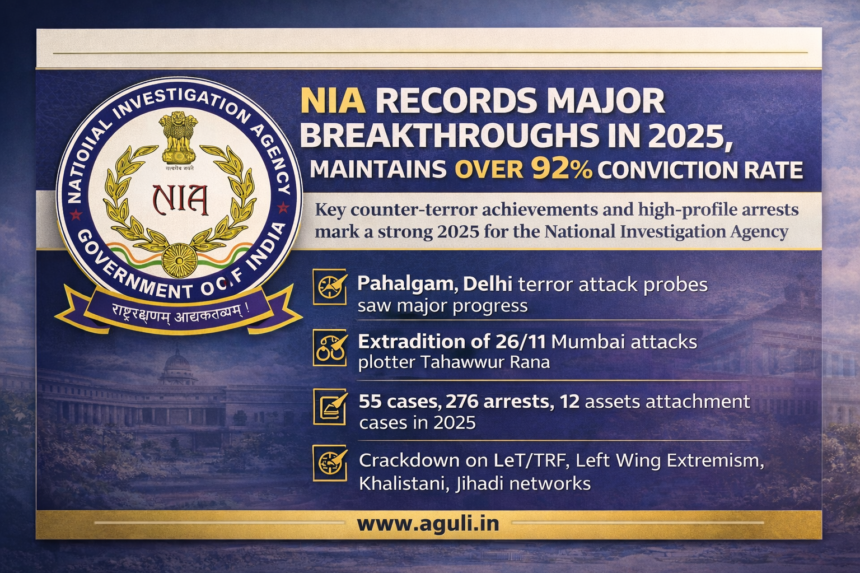
New Delhi, December 31, 2025: The National Investigation Agency (NIA) closed 2025 with a series of landmark achievements in counter-terrorism and organised crime investigations, maintaining an impressive conviction rate of over 92 per cent, according to its year-end press release.
One of the most significant milestones of the year was the successful extradition of 26/11 Mumbai terror attack mastermind Tahawwur Rana from the United States to India in April 2025. The extradition marked a major breakthrough in the long-running investigation into the 2008 Mumbai terror attacks that claimed 166 lives. Rana is facing trial for his role in planning the attacks and other terror activities across the country.
The agency also registered major progress in the Pahalgam and Delhi terror attack cases, arresting several terrorists and associates linked to these incidents. In the Pahalgam terror attack probe, the NIA filed chargesheets against seven accused, including members of the Pakistan-based Lashkar-e-Taiba (LeT) and its affiliate The Resistance Front (TRF), which was declared a terrorist organisation. Three terrorists involved in religion-based targeted killings were neutralised by security forces.
Another key development was the deportation of gangster Anmol Bishnoi from the United States, a close associate of the Lawrence Bishnoi gang, who had been absconding since 2022. The NIA is pursuing speedy trial proceedings against him in cases involving criminal syndicates conspiring to carry out terror activities in Delhi and other parts of India.
In the Delhi Red Fort car blast case, the agency achieved rapid success by arresting nine accused within two months of the terror attack, which killed one person and injured several others.
Throughout the year, the NIA intensified its action against Left Wing Extremism (LWE) in line with the central government’s goal of making India completely Naxal-free by March 31, 2026. The agency took up nine investigations related to LWE, chargesheeted 34 accused, and worked closely with state police and central armed police forces, including the CRPF.
Overall, the NIA registered 55 cases in 2025 and made 276 arrests, including 67 accused in jihadi cases, 74 in LWE cases, 37 in North-East insurgency cases, 28 in Khalistani terror cases, 11 in gangster cases, and 59 in other categories. The agency secured 66 convictions and filed chargesheets against 320 accused during the year. As part of its crackdown on terror financing and organised crime, 12 properties and assets were attached.
Nationwide search operations conducted across the year resulted in the arrest of around 200 accused linked to terror and organised crime networks. These operations also targeted designated Khalistani terrorists and dismantled their support structures.
The NIA made substantial progress in probing human trafficking networks, including cross-border rackets involving Bangladeshi and Myanmar nationals and cases where Indian youth were trafficked through the illegal ‘dunki’ route or forced into cyber slavery in the Golden Triangle region of Laos and Cambodia.
The agency continued strong action against ISIS, Al-Qaeda, HuT, and other jihadi organisations involved in radicalisation, recruitment, and terror conspiracies. Simultaneously, it pursued investigations into pro-Khalistani elements, their links with organised crime syndicates, and foreign-based handlers.
Significant breakthroughs were also reported in cases involving ULFA-I and NSCN-IM insurgent groups in the North-East, recovery of arms, ammunition and explosives, and the seizure of illegal weapons including AK-47 rifles smuggled into Bihar as part of a larger anti-national conspiracy.
In addition, the NIA achieved convictions in several targeted killing cases, including those of Praveen Nettaru, Ramalingam, Kerala professor T.J. Joseph, and others. The agency also made progress in Pakistan-linked naval espionage cases and multiple Fake Indian Currency Notes (FICN) investigations across states.

To keep pace with evolving terror and crime patterns, the NIA introduced major technical and operational advancements, including the development of a Lost/Looted Recovered Government Weapons Database and an Organised Crime Network Database, aimed at strengthening real-time information sharing among security agencies.
The agency also conducted specialised workshops on cryptocurrency-related crimes and continued to enhance infrastructure and inter-agency collaboration to reinforce India’s counter-terror capabilities.
The NIA said its achievements in 2025 reaffirm its commitment to safeguarding national security and dismantling terror, insurgency, and organised crime networks across the country.