






Dr. Utpal Dey, SMS (Plant Protection), Krishi Vigyan Kendra, Sepahijala
Dr. Shatabhisa Sarkar, Senior Scientist & Head, Krishi Vigyan Kendra, Sepahijala
Prof. A. B. Patel, Dean, College of Fisheries, Central Agricultural University (I), Tripura
Introduction
Natural farming is emerging as an important pathway towards sustainable agriculture by reducing dependence on synthetic fertilizers and pesticides while enhancing soil biological health, resource-use efficiency and farm profitability. In Tripura, where small and marginal farmers face challenges related to high input costs, soil degradation, pest pressure and inefficient utilization of available resources, location-specific natural farming practices can provide a viable and eco-friendly alternative.
With this objective, Krishi Vigyan Kendra (KVK), Sepahijala, demonstrated natural farming practices in different cropping systems, with particular emphasis on intercropping and the use of indigenous biological inputs. Maize–green gram, cauliflower–marigold and potato-based natural farming systems were evaluated for their productivity, profitability, soil health improvement and potential for wider adoption among farming communities.
Sustainable Practices Adopted for Promotion of Natural Farming
The maize–green gram intercropping system under natural farming was designed to promote chemical-free agriculture while improving resource-use efficiency. The system included Beejamrut seed treatment, application of Ghan Jeevamrut at 500 kg/ha, straw mulching at 10 t/ha, and foliar application of Jeevamrut (5%) and Neemastra (5%). The integration of maize with green gram enabled better utilization of available resources and contributed to biological nitrogen fixation. The system recorded a maize yield of 5,193 kg/ha and green gram yield of 504 kg/ha, resulting in a maize equivalent yield (MEY) of 7,912 kg/ha. The net return was ₹63,724/ha, with a benefit-cost ratio (BCR) of 1:2.50. The system demonstrated that indigenous natural inputs, combined with intercropping, can reduce dependence on external chemical inputs while maintaining productivity and profitability.
The cauliflower–marigold intercropping system was another successful natural farming model. Beejamrut seed treatment, Ghan Jeevamrut at 500 kg/ha, and foliar applications of Jeevamrut (5%), Neemastra (5%) and Bramhastra (5%) were used for nutrient supplementation and natural pest management. The integration of cauliflower with marigold provided an opportunity for diversified income while supporting ecological pest management and efficient utilization of land and other resources. The system achieved a cauliflower yield of 9,027 kg/ha and 3,25,725 marigold flowers/ha, generating a net return of ₹1,11,876/ha and a BCR of 1:5.81. The high economic return demonstrates the potential of vegetable–flower intercropping as a profitable and environmentally sustainable natural farming model for the region.
A potato-based natural farming demonstration was also undertaken using Beejamrut for seed treatment, Ghan Jeevamrut at 500 kg/ha, straw mulching at 10 t/ha, and foliar applications of Jeevamrut (5%), Neemastra (5%) and Bramhastra (5%). The practices were aimed at improving soil biological activity, conserving soil moisture and managing pests through indigenous formulations. The system recorded a potato yield of 16,947 kg/ha, a net return of ₹88,970/ha, and a BCR of 1:2.11. The results indicate that staple crops such as potato can also be successfully cultivated under natural farming conditions without dependence on synthetic fertilizers and pesticides.
Improvement in Soil Health and Biological Activity
One of the significant observations across the demonstrated natural farming systems was the improvement in soil biological activity. Regular application of organic formulations such as Jeevamrut and Ghan Jeevamrut, together with straw mulching, contributed to an increase in the microbial load of the soil. Enhanced microbial activity facilitated nutrient mineralization, improved nutrient availability and uptake by crops, and contributed to better overall soil fertility.
The increased biological activity also supported improved soil moisture conservation and a more favourable soil environment for crop growth. Thus, rather than relying primarily on externally supplied synthetic nutrients, the natural farming approach focused on activating the biological processes already present within the soil ecosystem.
Adoption and Extension Approaches
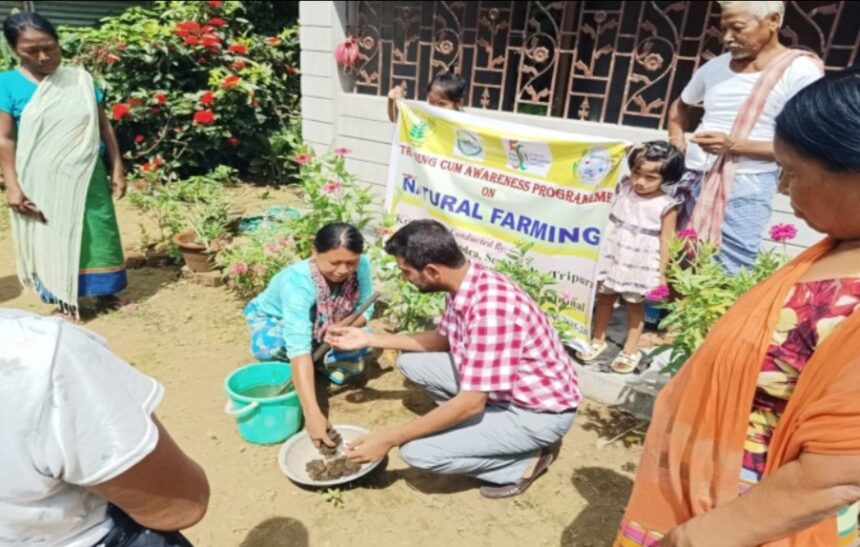
The natural farming demonstrations provided an important platform for farmer learning and technology dissemination. Farmers were exposed to the preparation and application of indigenous inputs, including Beejamrut, Ghan Jeevamrut, Jeevamrut, Neemastra and Bramhastra, as well as practices such as straw mulching and intercropping.
The economic performance of the demonstrated systems played an important role in encouraging neighbouring farmers to adopt the practices. The maize–green gram system demonstrated the benefits of crop diversification and biological nitrogen fixation, while the cauliflower–marigold system offered particularly attractive returns through the production of both vegetables and flowers. The potato demonstration further established the feasibility of natural farming in an important staple crop.
Field-level observation of improved soil condition, moisture retention, crop performance and reduced dependence on purchased chemical inputs strengthened farmers’ confidence in the technology. The availability of safe, chemical-free produce and the possibility of obtaining higher economic returns further encouraged neighbouring farmers to adopt natural farming practices.
Commercialization and Market Linkages
Commercialization of natural farming produce is being undertaken through organized local marketing channels. The enterprise has obtained firm registration from the Sub-divisional Zonal Development Office, Jampuijala, for the sale of chemical-free natural farming products. In addition, the cultivated lands have been applied for PGS certification, which is expected to further strengthen consumer confidence and market recognition of the produce.
The natural farming products are marketed through natural farming outlets and are also supplied directly to school hostels, hotels, wholesalers and local buyers in Agartala. These market linkages are helping to expand the market for safe and naturally produced food while creating sustainable income opportunities for farmers adopting natural farming practices.
Conclusion
The natural farming demonstrations conducted under maize–green gram, cauliflower–marigold and potato-based systems in Sepahijala district of Tripura demonstrate the potential of integrating intercropping, indigenous natural inputs, soil biological activation and ecological pest management for sustainable agricultural production.
Among the demonstrated systems, cauliflower–marigold recorded the highest economic performance, with a net return of ₹1,11,876/ha and a BCR of 1:5.81, while maize–green gram and potato also generated attractive returns with BCRs of 1:2.50 and 1:2.11, respectively. The results indicate that natural farming can contribute not only to reduction in chemical input use but also to improved resource-use efficiency, diversified farm income and restoration of soil biological health.
The increase in soil microbial activity and associated improvement in nutrient availability, nutrient uptake and moisture conservation are particularly important from the perspective of long-term soil health. The growing adoption of these practices by neighbouring farmers indicates that visible field-level benefits, economic returns and access to markets can play a critical role in accelerating the transition towards natural farming.
Overall, these models provide a promising pathway for promoting safe food production, sustainable soil management, reduced input dependence and improved farm profitability in Tripura. Their wider dissemination through farmer demonstrations, capacity building, institutional support, certification and organized market linkages can contribute significantly to the development of resilient and sustainable farming systems in the region.
Conference Note
This article has been prepared for publication on the occasion of the forthcoming three-day National Conference on “Natural Farming: Pathways to Self-Reliant Farming and Rural Prosperity”, with the motto “One Farm, One Ecosystem and One Health,” scheduled to be held from 9–11 September 2026 under the aegis of Central Agricultural University (I), Manipur, at the College of Post Graduate Studies in Agricultural Sciences, Umiam, Meghalaya.