






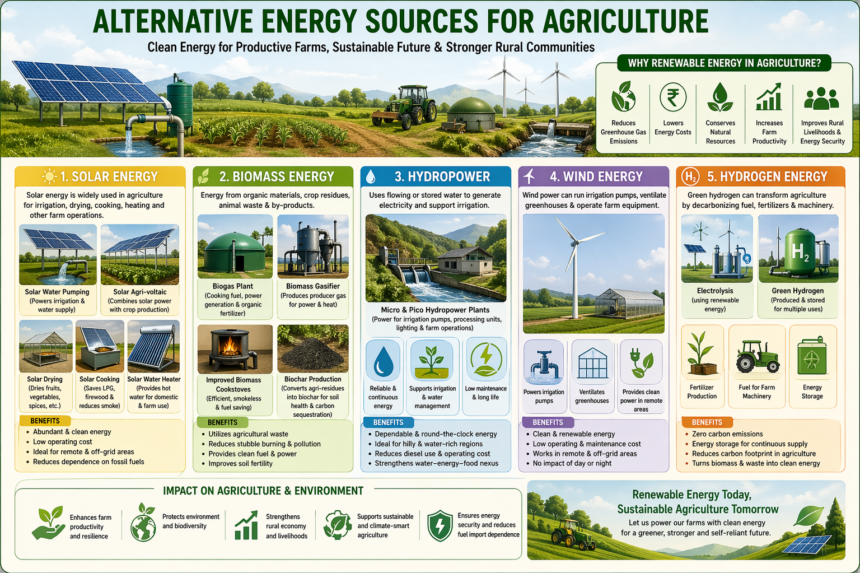
Agriculture is highly dependent on energy for irrigation, machinery operation, crop processing, storage, and transportation. Traditionally, this energy has been derived from fossil fuels such as diesel and coal, which contribute significantly to greenhouse gas emissions and climate change. Renewable energy sources provide a sustainable alternative that can reduce environmental impacts while improving farm productivity, rural livelihoods and relief from the present energy crisis. With rapid technological advancements and declining costs, renewable energy is increasingly integrated into agricultural systems worldwide. The major renewable energy sources used in agriculture are solar, biomass, hydro power, wind and hydrogen.
Solar Energy
Solar energy is the most widely used and fastest-growing renewable energy source in agriculture. Photovoltaic (PV) modules convert sunlight into electricity, which can power irrigation pumps, lighting systems, greenhouse climate control, and farm machinery. Solar-powered irrigation systems are particularly beneficial for farmers in remote areas where grid electricity is unavailable. Applications of solar energy in agriculture include: Solar water pumping, Solar agri-voltaic, Solar drying, Solar cooking, and Solar water heater.
Solar Water Pumping Technology
Water pumping is one of the simplest and most appropriate uses for photovoltaic. From crop irrigation to stock watering to domestic uses, photovoltaic-powered pumping systems meet a broad range of water needs. A solar photovoltaic water pumping system consists of a photovoltaic array mounted on a stand and a motor-pump set compatible with the photovoltaic array. It converts the solar energy into electricity, which is used for running the motor pump set to draw water from the open well, bore well, streams, ponds, canal, etc.
Solar Agri-voltaic Technology
Solar Agri-voltaic Technology (Agrivoltaics) is a system in which solar photovoltaic (PV) panels and agricultural crops are produced on the same land simultaneously. Agri-voltaicsinvolve installing solar photovoltaic (PV) panels above or alongside crops, allowing farming activities to continue underneath or between the modules. This technology is an innovative approach that combines renewable energy generation with agricultural production, improving land efficiency, farmer income, and environmental sustainability.
Solar Drying Technology
The solar dryers have many applications in industries and agriculture. Traditionally, drying of agricultural products is done on the open ground directly under the Sun, that leads to losses due to uncontrolled drying, besides causing contamination of the product. The College of Agricultural Engineering and Post Harvest Technology, Central Agricultural University, Ranipool, Gangtok, Sikkim has developed many solar dryers as follows:
Mixed Mode Photovoltaic Powered Forced Convection Solar Dryer: It is a combination of direct and indirect solar dryers. Product may dry with both direct exposure to solar radiation and hot air supplier on it. The dryer had capacity to dry10 kg of drying product, and is suitable for drying all kinds of agricultural and horticultural products like turmeric, ginger, leafy vegetables, fruits, cherry pepper, large cardamom etc. The drying time varies from 18 to 24 Solar hours (i.e., 2-3 days).
Solar Biomass Hybrid Dryer for Large Cardamom Drying: The solar biomass hybrid dryer (10-15 kg capacity)consisting of a solar collector, a down draft biomass gasifier and a drying chamber was designed and developed with drying capacity of 20 kg per batch of large cardamom within 12-15 hours of operation.
Portable PV Powered Forced Convection Solar Dryer:This dryer (capacity 5-10 kg) has four main components viz. flat plate collector, drying trays, exhaust fan and solar PV module. Being light weight, this dryer is highly suitable for high altitude and portability supports hilly region utility, and can dry products within 20-24 solar hours (i.e.,2-3 days).

Direct Type Natural Convection Solar Dryer for Drying of Large Cardamom: The solar dryer (capacity 7-10 kg) designed and developed for large cardamom is capable of producing the optimum temperature in the range of about 55oC to 60oC for drying of large cardamom within 20-24 solar hours (i.e., 2-3 days).
Solar Tunnel Dryer: The solar tunnel dryer consists of solar air collector cum drying chamber. The drying chamber is divided into multiple trays. It can accommodate drying of 75 to 200 kg product within 10-22 solar hours (i.e., 1.5-3.0 days), and supports all sorts of agricultural and horticultural products.
Solar Cooking Technology
Solar cooker is a device which uses solar energy for cooking and thus saving petroleum resources (LPG & Kerosene), fuel wood, and electrical energy to a large extent. It is a simple cooking unit, ideal to domestic cooking during most part of the year except during the monsoon season, cloudy days and winter months. The box type solar cooker with a single reflecting mirror is most popular in India. It works as an airtight box with double glass covers. A reflector is placed over it for boosting the solar radiation thus increase intemperature. Box type solar cookers are capable for cooking different types of food including rice, vegetables, pulses, chicken and fish, etc. A family size box type solar cooker is sufficient for 4 to 5 members, that save about 3 to 4 cylinders of LPG every year.
Solar Water Heater Technology
Most solar water heating systems have two main parts: a solar collector and a storage tank. The most common solar collector is called a flat plate solar collector. It consists of a thin flat, rectangular box with a transparent cover that faces the sun, mounted on the roof of building or home. Small tubes run through the box and carry the fluid-either water or other fluid, such as an antifreeze solution to be heated. The tubes are attached to an absorber plate, which is painted with special coating to absorb the heat. The heat builds up in the collector, which is passed to the fluid passing through the tubes. An insulated storage tank holds the hot water. Presently, the solar water heater is used for domestic, commercial and industrial applications. A temperature of 60oC is sufficient for domestic use. Most domestic solar water heaters are capacity ranging from 100-500 litres per day. A typical solar water heater can save up to 1500 units of electricity every year, for every 100 litres per day of solar water heater. A solar water heater of 100 litres capacity can prevent emission of 1.5 tons of carbon dioxide per year. Solar water heater has a life of 15 to 20 years and pays back the cost in 3 to 4 years when electricity is replaced. Solar water heaters ranging from 100 to over 20,000 litres per day capacity at 85oC to 90oC have been installed in hostels, guest houses, hotels, industries, etc.
Biomass Energy
Biomass energy is produced from organic materials such as crop residues, animal waste, and agricultural by-products. Biomass can be converted into biogas, bioethanol, or biofuel for farm operations. Agricultural residues represent a massive renewable resource. India’s bioenergy capacity, approaching 12 GW, includes bagasse-based cogeneration, biomass combustion, and biogas systems. These are especially critical in states like Punjab, Maharashtra, and Uttar Pradesh where agricultural residues pose both an opportunity and a challenge. India’s SATAT (Sustainable Alternative Towards Affordable Transportation) scheme and National Bioenergy Mission are expanding the scope for compressed biogas (CBG), biomass briquetting, and co-firing in thermal plants to reduce dependence on fossil fuels and manage stubble burning. The College of Agricultural Engineering and Post Harvest Technology, Central Agricultural University, Ranipool, Gangtok, Sikkim has developed many biomass energy conversion technologies as follows:
Portable Box Type Biochar Kiln: A portable kiln designed for slow pyrolysis, converts 4-5 kg of agricultural residues (straw, stems, leaves, etc.) into carbon-rich biochar at 400-500 °C in the absence of air.
Movable Fixed bed type Pyrolyzer for Biochar Production: A movable fixed bed pyrolyzer was developed to convert 10-15 kg agricultural residues into biochar, achieving an average recovery rate of 41% and consistent performance across various feedstocks.
Fast Pyrolyzer for Bio-oil Production from Agricultural Crop Residues: A fast pyrolyzer efficiently converts 10-12 kg agricultural residues like turmeric waste, paddy straw, and corn cobs into bio-oil within seconds, using high temperatures and rapid heating. This process enables effective valorizationof agri-waste into renewable liquid fuel for energy and chemical use.
Multimode Improved Metallic Biomass Cookstove: This innovative cookstove having power rating of 1.2 to 3.5 kW integrates four operating modes-top-fed, front-fed, and both with/without chimney-within a single, efficient design. Developed to cater to varying fuel types (1-3 kg), combustion needs, and cooking styles of the hilly North Eastern Region, the stove combines the advantages of Top Lit Updraft (TLUD) gasifier and traditional stove. Being the portable cookstove it weighs around 5-7 kg including accessories for chimney. It can be used indoor as well as outdoor cooking. The efficiency ranges from 28 to 38% for various modes.
Energy Efficient Double Pot Improved Biomass Cook Stove: The energy efficient double pot improved biomass cook stove having two pot holding places is designed to meet the cooking requirement of the hilly region.
Portable Side Feed Smokeless Cook Stove: This is a portable and light weight insulated metallic biomass cookstove, which uses long size fuel wood sticks for continuous operation. This cookstove weighs around 5 kg and is suitable for a family of 5 people with rated capacity of 1-2 kW.
Biogas Technology
Biogas is produced through the anaerobic digestion of organic materials in a closed digester called as Biogas Plant in the presence of microorganisms. The organic feedstock, such as cattle dung, agricultural residues, municipal and industrial wastes, food wastes, wastewater sludge, etc., can be used as feed material. Biogas contains mainly two major gases, methane (40-65%) and carbon dioxide (30-40%), with traces of other gases having a calorific value between 4500 and 5500 kcal/m3. Biogas has multiple applications and can be used for cooking, heating, and lighting, as well as for power generation. Electricity can be used for household lighting as well as for agricultural applications for irrigation, dairy, etc. One m3 of Biogas Plant is suitable for a family of 3-4 persons for cooking food. The byproduct of biogas plant, known as digested slurry, serves as an excellent organic fertilizer. It contains nitrogen, phosphorus, and potassium (NPK), essential for plant growth. It easily mixes with the soil and works as a soil conditioner, improving soil texture, moisture retention, and microbial activity. Digested slurry enhances plant resilience against pests and diseases. It also helps in reducing dependency of farmers on chemical fertilizers, making farming more sustainable with increased crop yield.
Types of Biogas plants
Floating drum type biogas plant
• KVIC Model (Khadi and Village Industries Commission): The most common type, featuring a cylindrical, underground brick-lined digester with a central partition wall. The gas holder is generally made of mild steel.
• Pragati Model: A modification featuring a hemispherical brick-masonry digester, designed to be more cost-effective than the standard KVIC model.
• Ganesh Model: A design utilizing angular steel and plastic foil to reduce the cost of the floating gas holder.
• ARTI Plant (Appropriate Rural Technology Institute): A compact, low-cost floating-drum plant designed for urban and semi-urban areas, often using high-density polyethylene (HDPE) or fiberglass drums (e.g., 100-200 litres) to treat kitchen waste.
Fixed dome type biogas plant
• Janata Type Plant: Introduced in India, it is fully constructed from bricks and cement. It has a high capacity and a long life, often used for community-level systems.
• Deenbandhu Model: Developed to be more cost-effective and efficient than the Janata type. It is smaller and designed for individual household use, utilizing a spherical dome construction to reduce construction costs and minimize leakage.
• Ferro-cement Plants: These use ferrocement for construction, offering a high-strength alternative for small-scale (under 6 m3) applications, though they require specialized construction skills.
The Ministry of New and Renewable Energy (MNRE) provides Central Financial Assistance (CFA) for setting up Biogas Plants for clean cooking fuel, lighting, meeting thermal and small power needs.
Biomass gasification Technology
Biomass gasification is thermo-chemical conversion of solid biomass into a combustible gas mixture called as producer gas or syngas through a partial combustion route with air supply restricted. Woody biomass, agricultural residues can be used as feedstock for gasification. Typical producer gas contains carbon monoxide (18-20 %); hydrogen (15-20 %); methane (1-5 %); carbon dioxide (9-12 %); nitrogen (45-55 %) and the calorific value ranges between 1000-1200 kcal/m3. The producer gas can be utilized in internal combustion engines (ICs) coupled with generators for electricity generation. Many heating applications in industry can be replaced with producer gas instead of conventional energy sources such as oil. The producer gas can be used for synthesis of several chemicals as well as for bio-hydrogen production through steam gasification. Biomass gasification results in relatively clean and environmentally acceptable practices. There are many gasifiers available for use with wood or woody biomass; some can even be used with rice husk.
Types of biomass gasifier

• Updraft (Counter-current) Gasifier: Biomass is fed at the top, air/agent enters at the bottom. It is simplest type with high thermal efficiency. It can handle high-moisture biomass well (up to 60%), but produces high tar levels. These gasifiers are ideal for direct thermal applications.
• Downdraft (Co-current) Gasifier: Air/gasification agent enters from the sides; gas and biomass move downward together. The tar content is lower as it passes through the combustion zone, cracking it down. It produces cleaner, low-tar gas suitable for internal combustion engines but has lower efficient than updraft.
• Cross-draft Gasifier: Air is injected through a nozzle on one side, and gas exits opposite. It gives a rapid response to load changes, suitable for small-scale units. These gasifiers require low ash/tar fuel. They are simple to construct but not suitable for high tar producing biomass.
• Fluidized Bed Gasifier: Biomass is suspended in a hot, upward-moving bed of sand, creating uniform temperatures. They are further classified asbubbling or circulating fluidized beds gasifiers.
Hydropower
Hydropower is emerging as one of the most dependable and versatile renewable energy solutions for agriculture, particularly in regions where availability of water determines commercial crop cultivation. Unlike conventional energy sources, hydropower does not just generate electricity but it simultaneously supports irrigation, water storage, and helps in climate resilience. Hydropower is most valuable in hilly and water-rich regions such as the northeastern hills where gravity-fed systems and small streams can be effectively harnessed with small and micro hydal Plants. By integrating hydropower into agricultural practices, farmers can reduce their dependence on diesel pumps and erratic grid electricity. This shift not only cuts operational costs but also shields farmers from fluctuating fuel prices. More importantly, it strengthens the energy-water-food nexus by ensuring reliable irrigation while promoting sustainable energy use. For smallholder farmers facing water scarcity and rising energy costs, micro and pico hydropower systems offer a practical, low-maintenance solution that enhances productivity and long-term resilience.
Wind Energy
Wind energy is a vast renewable energy source which can make agriculture more sustainable and cost-efficient. In areas with consistent wind flow, small-scale wind turbines can be used to operate irrigation pumps, ventilate greenhouses, and power farm equipment. This reduces reliance on fossil fuels while lowering greenhouse gas emissions which leads towards climate resilient-smart farming. For farmers, the benefits go beyond environmental gains. Wind-powered systems can significantly reduce electricity bills and provide a reliable energy source in remote areas where grid access is limited or unreliable and has no impact of day or night like in solar energy. This is particularly important for operations like irrigation and greenhouse climate control, which are energy-intensive yet critical for maintaining crop yields under changing climate conditions. As technology becomes more affordable and efficient, wind energy is poised to play a larger role in modern agricultural systems.
Hydrogen Energy
Looking ahead, hydrogen energy offers a transformative pathway for decarbonizing agriculture. Green hydrogen produced through electrolysis using renewable energy can be used in multiple ways, from manufacturing fertilizers to fueling agricultural machinery. This innovation has the potential to drastically reduce the carbon footprint of farming, particularly in nitrogen fertilizer production, which is traditionally energy-intensive. Hydrogen also serves as an effective energy storage medium, addressing one of the biggest challenges of renewable energy intermittency. Excess energy from solar or wind can be stored as hydrogen and can be used later, ensuring a continuous power supply for farm operations. This makes it highly suitable for integrated farm energy systems, where multiple renewable sources work together. Agricultural residues and biomass can be converted into hydrogen, turning waste into valuable energy. With localized production and storage systems, farming communities can achieve greater energy security and independence from external fuel markets.
Renewable energy plays a crucial role in transforming modern agriculture into a more sustainable and environment friendly system. Solar, biomass, hydropower, wind, and geothermal energy offer clean and reliable energy solutions for farming activities, and relief of the growing energy crisis out of the current geopolitical issues. With continuous technological advancements, supportive policies, and increasing environmental awareness, renewable energy is expected to become a central component of future agricultural systems. The integration of renewable technologies not only reduces carbon emissions but also enhances farm productivity, rural development, and energy security.