





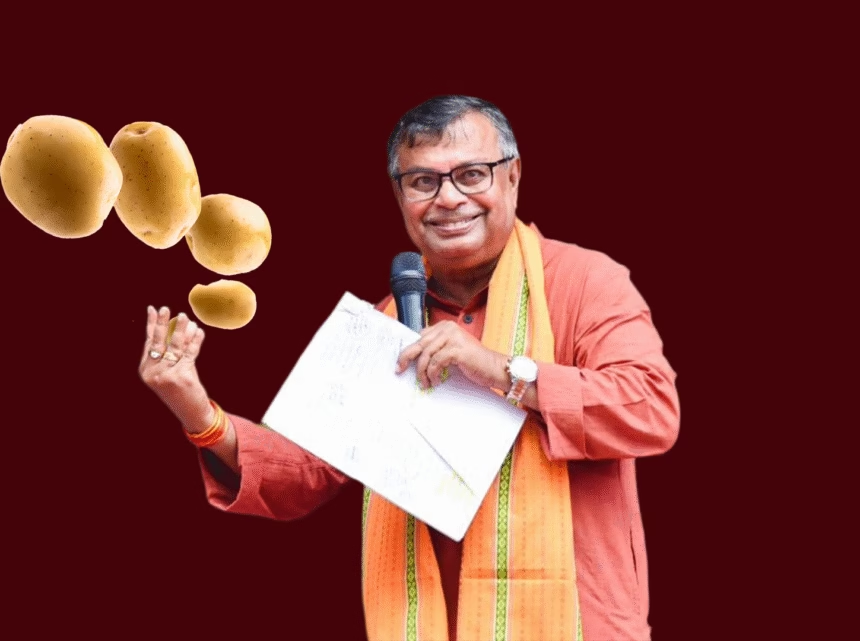
Tripura, 12 Sep 2025: Tripura is set to become self-sufficient in potato production by the financial year 2028-29. Not only will the state meet the demand of every household within its boundaries, but by 2029-30, it is also expected to export surplus potatoes to other states of India. Agriculture and Farmers’ Welfare Minister Ratan Lal Nath announced this today at a press conference held in his office at the State Secretariat.
The minister further informed that along with achieving self-reliance in potato production, a potato chips processing center will also be established in Tripura. For this purpose, a project worth ₹35.53 crore has been formulated under the RKVY scheme for the 2029-30 financial year.
Highlighting the remarkable progress, the minister said that this year, Tripura achieved record potato yield by adopting the Apical Root Cutting (ARC) method, imported from Lima, the capital of Peru. Tripura has emerged as the top producer of potatoes in the country using this technique. The success has even drawn global attention, with Dr. Simon Heck, Director General of the International Potato Center, and Nirod Sharma, Country Manager, visiting Tripura to witness the achievement firsthand.
Currently, 23,745 farmers in Tripura are engaged in potato cultivation across 7,622 hectares of land. Previously, potato farming in the state relied on seeds brought from other states or through True Potato Seed (TPS), which yielded unsatisfactory results. However, since the introduction of the ARC method in the 2022-23 fiscal year, production has improved significantly.
Minister Nath expressed confidence that by 2029-30, Tripura would not only be self-sufficient in potato production but also in potato seed production. He also mentioned that a delegation from the state will visit Peru in May-June next year to further strengthen collaboration.
Under the ARC method, potato seeds were distributed to 104 farmers in 2022-23, 420 farmers in 2023-24, and will be provided to 4,000 farmers in the current financial year. The press conference was also attended by Deepak Kumar Das, Director of Horticulture & Soil Conservation Department, and Dr. Rajib Ghosh, Deputy Director of the department.