



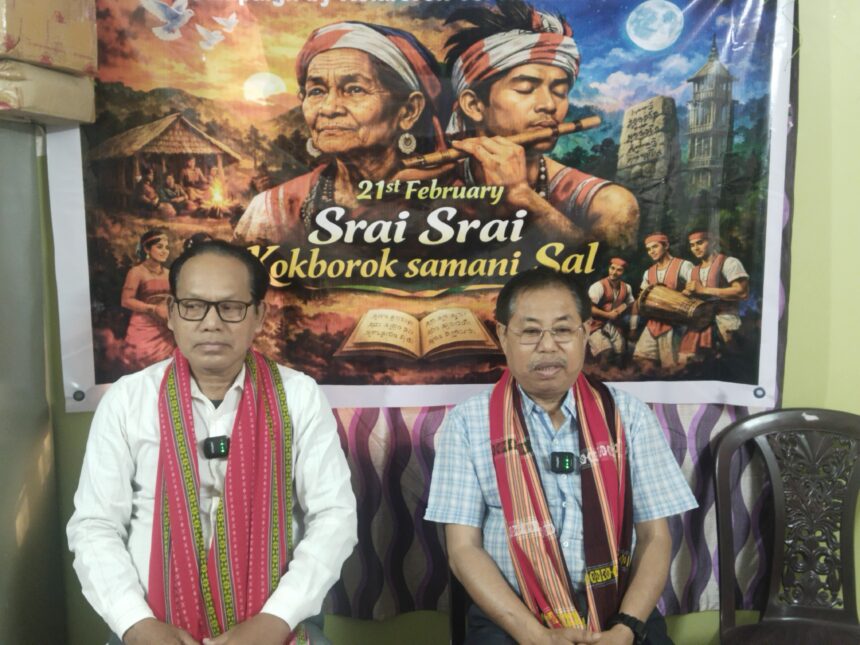
Agartala, Feb 18: In a determined bid to protect and revitalise Kokborok, Kokborok tei Hukumu Mission (KOHM), a non-political and non-religious organisation, has declared that February 21 will be observed as “Srai Srai Kokborok Sal” across Tripura.
The announcement coincides with International Mother Language Day and signals the beginning of a sustained campaign dedicated to restoring the purity, dignity and cultural strength of Kokborok.
The inaugural observance will be held at the residence of Dr. Bijoy Debbarma at Nutan Palli, Krishnanagar. While this year’s programme will be modest, KOHM intends to gradually extend the observance to schools, colleges and institutions to ensure wider public participation and awareness.
Addressing the media, KOHM President Dr. Bijoy Debbarma underlined the historic importance of International Mother Language Day, recalling the resistance against the imposition of Urdu over Bangla in erstwhile East Pakistan. He stated that the day symbolises the collective responsibility of communities to defend and nurture their mother tongues.
Dr. Debbarma voiced concern over what he termed the gradual erosion of Kokborok in Tripura. He alleged that many traditional Kokborok names of villages, rivers and natural landmarks were changed over time. He further noted that personal names rooted in Kokborok identity were often replaced under socio-cultural pressures, weakening linguistic heritage.
He also highlighted the growing tendency to mix Kokborok with other languages, observing that even public representatives frequently struggle to deliver speeches in pure Kokborok. According to him, safeguarding linguistic purity is directly linked to preserving cultural identity and historical continuity.
Declaring this year’s observance as a “Pure Kokborok Speaking Day,” KOHM has urged all Kokborok speakers to communicate exclusively in Kokborok on February 21 as a symbolic yet meaningful step toward language preservation.
Hukumu Mission General Secretary Dr. Binoy Debbarma detailed the organisation’s ongoing initiatives, including cultural programmes and book publications aimed at strengthening Kokborok. He also proposed collaboration with Kokborok media houses to promote the use of pure language in news broadcasts and announced plans for a one-day workshop for media professionals.
The organisation has appealed to all Kokborok-speaking communities to actively participate in the observance and contribute collectively to securing the future of the language for generations to come.