




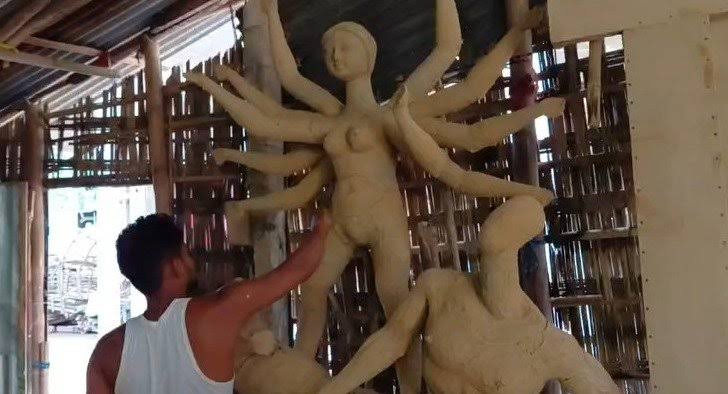
Agartala, September 26: The hands that give shape to Durga and other Hindu deities are working overtime in Kalyanpur as Durga Puja approaches. Yet, behind the growing demand for idols, traditional artisans are facing a difficult season, with higher raw material and labour costs, fewer skilled workers and uncertain returns threatening their age-old livelihood.
Among those navigating these challenges is veteran artisan Bhuban Rudrapal of Kalyanpur Bazar Colony. For almost two decades, he has been creating clay idols, a profession he turned to after finding it difficult to make ends meet as a fish vendor.
Rudrapal once travelled across tribal-dominated areas selling fish to support his family. However, inadequate earnings eventually pushed him to explore another livelihood. He began learning the intricacies of idol-making from his brother-in-law while continuing to sell fish.
“I learned the craft of making idols from clay from my brother-in-law while continuing to sell fish. Later, I left fish vending and took up idol-making full-time. I would make idols at home according to my own designs,” Rudrapal said.
What started as a means of earning a livelihood gradually became a passion. Over the years, he crafted idols of Manasa, Kali, Vishwakarma, Loknath, Bipadnashini, Durga and Lakshmi, attracting customers from Kalyanpur and neighbouring areas.
His home workshop once remained busy with orders. However, the financial equation of idol-making has changed considerably over the years.
Clay, straw, bamboo and paint — all essential for making an idol — have become more expensive. Labour charges have also increased, while finding experienced artisans has emerged as another major challenge.
“Compared to earlier, the cost of raw materials has increased significantly. Labour expenses have also gone up. The biggest problem is that it has become difficult to find skilled workers. After meeting all the expenses, there is very little profit left from making an idol,” he said.
The pandemic further deepened the difficulties faced by artisans. Restrictions on religious and public gatherings during COVID-19 resulted in fewer Puja celebrations and a steep decline in demand for idols. For traditional craftsmen, the impact was felt through reduced orders and mounting financial pressure.
Rudrapal now believes that government assistance is crucial to keeping the traditional craft alive. He said families associated with idol-making and pottery depend on the sector for their livelihoods, but several practical hurdles continue to affect them.
Access to affordable raw materials, financial assistance, skilled manpower and wider markets remain among the major concerns for artisans, he said.
Despite the challenges, Rudrapal’s workshop is once again busy ahead of Durga Puja. He has received orders for Maa Durga idols from different parts of Kalyanpur and from several tribal-dominated areas and is putting in long hours to finish them before the festival.

For him, every idol represents more than a religious figure. It is the product of years of traditional knowledge and painstaking manual work — a craft that is becoming increasingly difficult to sustain commercially.
Rudrapal believes that easier access to raw materials, financial support, skill-development initiatives and better marketing facilities could encourage artisans to remain in the profession and attract younger generations to the craft.
Until then, he continues to work with clay, straw and bamboo, patiently shaping the figures that will adorn Puja pandals across the region, while hoping that changing market conditions do not push this traditional craft towards extinction.