





Himanshu Priyadarshi, Arun Bhai Patel, AnindyaSundar Barman
The rapid expansion of global aquaculture has created significant energy demands, with energy consumption accounting for approximately 40% of total production costs in intensive systems. Currently, freshwater aquaculture in India is overwhelmingly dominated by carp culture in earthen ponds with bulk of production contributed by artisanal small scale farmers scattered in rural areas throughout the country. One of the major driving reasons for nationwide spread of carp culture has been the stable seed supply. However, major share of carp seeds are produced primarily utilizing cistern eco-hatcheries, followed by portable FRP (Fiber Reinforced Plastic) hatcheries. While these two systems are suitable for centralized areas dominated by aquaculture activities, they require a large volume of water—approximately 80,000 liters—to produce 1 million fry. Operating these systems requires nearly 375.1 kilocalories at 100% efficiency with an overhead tank at a 2-meter height. Although cistern eco-hatcheries and portable FRP hatcheries exhibit high spawning, fertilization and hatching efficiency, they require substantial energy for operation, typically supplied by fossil fuels or electricity. To run these hatcheries, owners usually operate 3–5 HP electric or fuel-based pumps almost continuously for nearly 60 hours. This requires 140–220 kWh of electricity, which is equivalent to 65–104 kg of CO2 emissions per cycle. Furthermore, hatcheries located in urban areas meet approximately 83% of their energy requirements through the grid, making them highly grid-dependent. Additional energy costs are incurred through water recycling treatments, while the distribution and transportation of seeds also rely heavily on fossil fuels. This dependence not only places a financial burden on farmers and the nation but also increases greenhouse gas (GHG) emissions.
In particular, in India’s North-Eastern states, small-sized ponds (0.17–0.5 hectares) pre-dominate the fish culture arena and are scattered and often are located in remote areas. Accordingly, long distance transportation of fish seeds from centralized fish seed production units through arduous undulating terrains is required to cater the needs of scattered small scale aquaculture units. For that matter, seed requirements of the state of Arunachal Pradesh even in remote areas is greatly met by transporting seed from long distances from neighbouring states. Such long distance transports leads to high post-stocking mortality impacting the overall aquaculture production as well as to high energy foot print. It is to emphasize that seed transport may require100 times higher water biomass relative to seed biomass.
The conventional approach to solve this problem has been through decentralized Hapa breeding. But, it is characterized with poor spawning, fertilization; hatching efficiency, making it erratic and unreliable. On the other hand, reliable power supply remains a major challenge in these remote regions. It is important to emphasize that fish hatcheries are particularly sensitive to energy disruptions, as embryonic development and larval survival depend on continuous aeration, thermal regulation, and water exchange. On the other hand, the solar energy offers a dual benefit—reducing environmental impact and shielding operators from rising energy costs—transitioning a standard cistern eco-hatchery to solar is expensive. A complete solar system (6 kW array, 30 kWh battery bank, and inverter) costs between ₹6,00,000 and ₹9,00,000, creating a significant financial burden on owners.
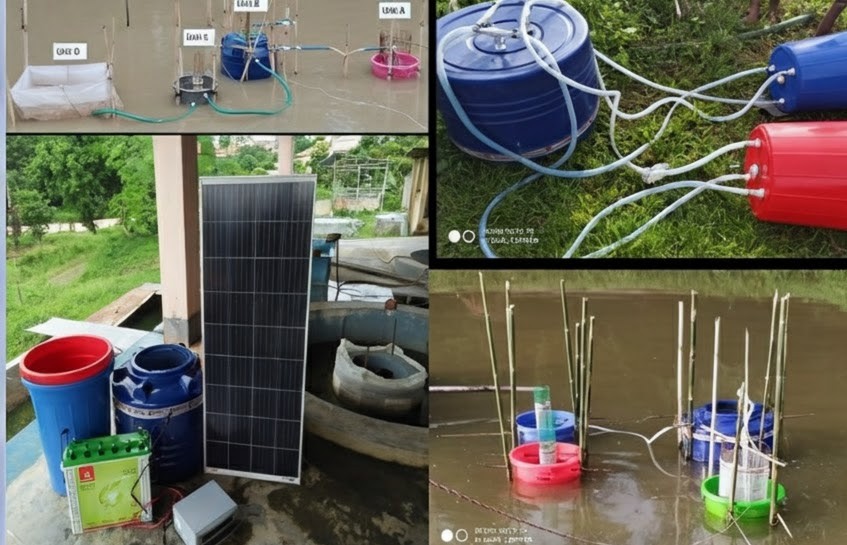
To address these challenges and utilize the boon of abundant solar energy, the College of Fisheries, Tripura has developed the CAU(I)-BRSHTI, a low-cost in-pond carp hatchery costing Rs. 12-15 thousand which has all the positive attributes of cement cistern eco-hatcheries and portable FRP hatcheries viz. high spawning and fertilization percentage but tremendously reduces both the energy requirement and water requirements. The developed in-pond hatchery unit is highly suitable for small-medium scale seed production of multiple species even in remote areas. It has been particularly optimized for seed production of multiple indigenous minor carps.
The unit was assembled using locally available materials with minimal engineering skills. It is a semi-automated, portable in-pond carp hatchery that operates with only a 50 W water pump-aerator, consuming merely 3.6 kWh per breeding cycle. The system draws cooler water from the metalimnion at a depth of 0.4 m for passive temperature adjustment, which is 5–7 °C lower than the surface water. Since this model uses a low volume of water and the same water is returned to the pond, there is no additional treatment required, in contrast to the cistern eco-hatchery. It also filters sediments and automates egg transfer. At high egg densities, it achieved approximately 93% fertilization and 80% hatching rates, with a benefit-cost ratio of 2.48.Under the Centre of Excellence on Fisheries and Aquaculture Biotechnology Phase-II, funded by the Department of Biotechnology, Government of India, this hatchery was upgraded for the production of 0.1 million carp fry per cycle. Additionally, a homestead solar battery inverter (cost around Rs. 25,000.00) was integrated into the hatchery. The operation of this design has been tested solely on the solar battery inverter at the College of Fisheries, Tripura, with an increased number of attached breeding pools. The backup system of the solar battery inverter allows continuous day-and-night operation without interruption. Production performance remained unaffected even on mildly rainy days, provided at least 3–4 hours of bright sunlight were available.This design is highly suitable for remote areas of North-East India and addresses the limitations of costly, non-portable Chinese eco-hatcheries. Economically, this portable hatchery can save up to 100% of energy costs through solar integration, offers a high benefit-cost ratio of up to 2.48, and provides rapid payback. Environmentally, it reduces GHG emissions and enhances climate resilience. Approximately, for the production of 1 million spawn from this hatchery using solar energy, the emission of 15.3 kg CO₂ can be avoided compared to when it is run on the grid. Comparing cistern-eco hatchery operation on the standard grid with CAU(I)-BRSHTI fully on a solar system, more than 50 kg CO₂ emissions can be avoided.
In the Indian context, especially among small and marginal farmers in the North-East, solar portable fish hatchery offer practical, low-capital pathways. Considering dispersed and remote farms in the North-Eastern states, which often face unreliable power supply and depend heavily on distantly located large eco-hatcheries, this not only decreases seed survival during transportation but also increases costs and carbon emissions. Such farms can establish their own units of this solar-integrated portable hatchery to meet their seed requirements. Socially, these technologies empower communities through training and create skilled jobs in solar-aquaculture management. They also open low-capital entrepreneurial pathways vis-a-vis more sustainable and resilient aquaculture production in the region through aiding species diversification with indigenous minor and medium carps. By catering the decentralized seed production, local aquaculture production also reduces risks, uncertainties and aid as the post-stocking survival, and thereby local aquaculture production.
Figure 1. Solar power integrated CAU(I)-BRSHTI for fish seed production