



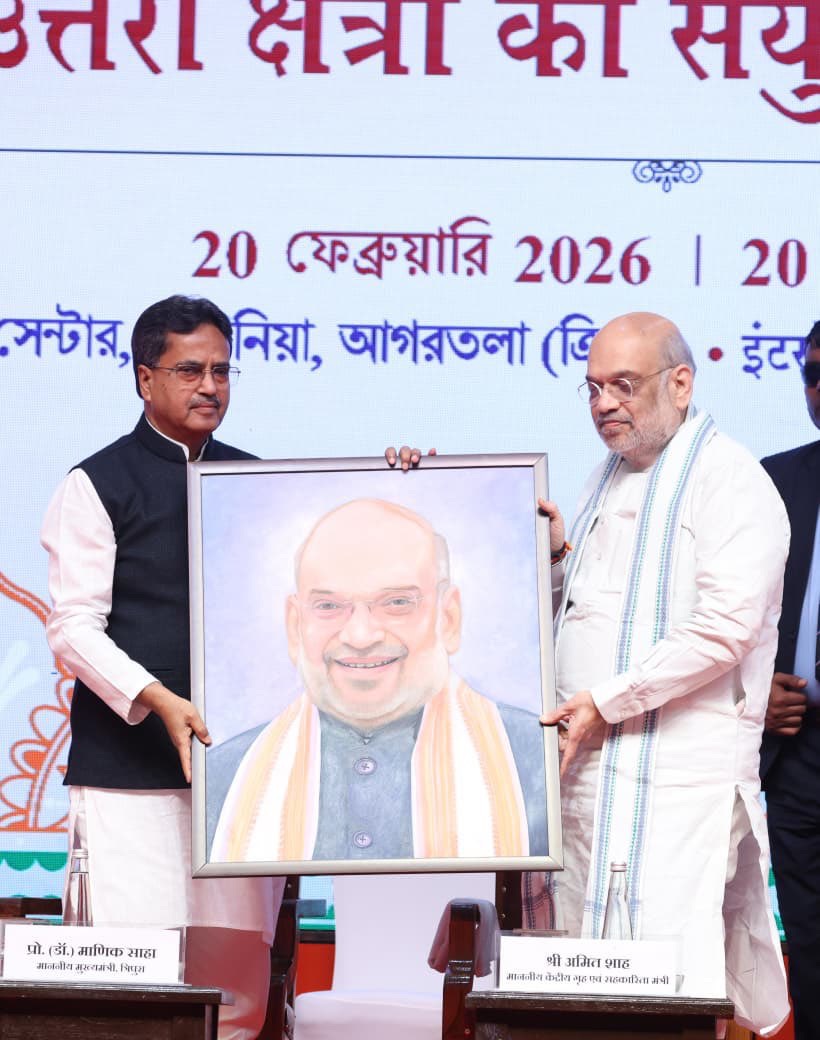
Tripura, 21 Feb 2026: Union Home Minister Amit Shah urged parents to communicate with their children in their mother tongue at home, emphasizing that knowledge of one’s native language is essential to understanding history, culture, and heritage. He made this appeal while inaugurating the Joint Regional Official Language Conference of Eastern, North-Eastern, and Northern regions at the Indoor Hall of the International Fair Ground in Hapania on Friday.
Addressing the gathering, Shah said that children must be taught to read and write in their mother tongue, irrespective of the language they use in formal education. “Without knowledge of their mother tongue, they will be deprived of their roots, history, and traditions,” he said.
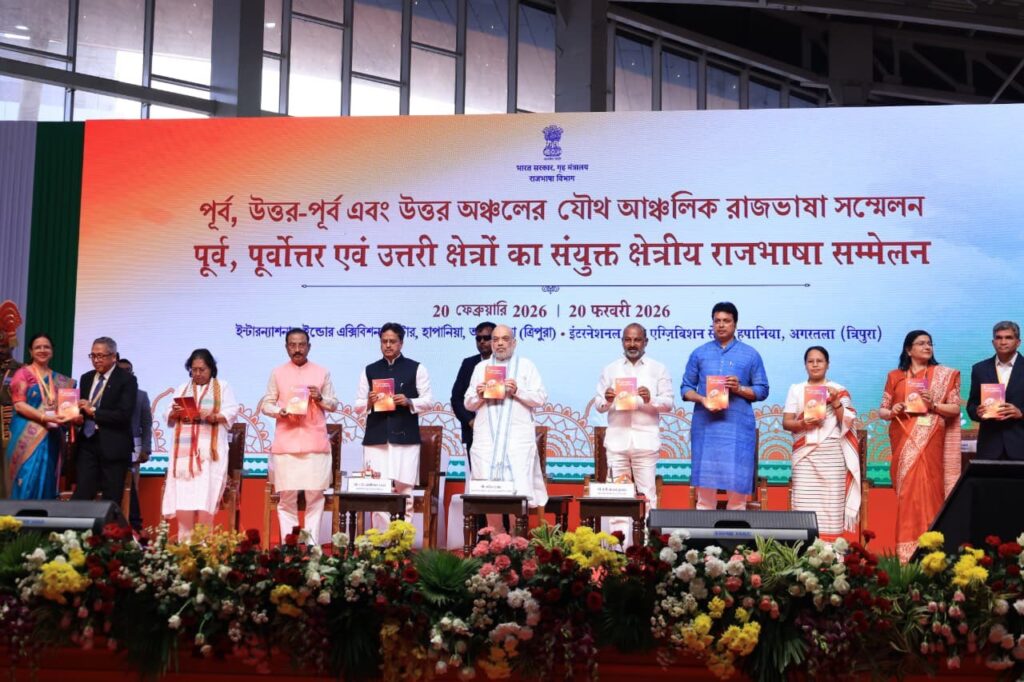
The event was attended by Chief Minister Prof. (Dr.) Manik Saha, Union Minister of State for Home Affairs Bandi Sanjay Kumar, MPs Biplab Kumar Deb, Kriti Devi Singh Debbarma, and Rajib Bhattacharjee, among others. The Chief Minister welcomed the Union Home Minister on the dais.
Emphasis on Language and National Identity
In his inaugural speech, Amit Shah referred to the ideals of Chhatrapati Shivaji Maharaj, stating that “Swaraj does not only mean self-governance, but also self-language, self-rule, and self-faith.” He noted that the framers of the Indian Constitution were inspired by Shivaji Maharaj in granting Hindi the status of the official language.
He clarified that there is no conflict between Hindi and regional languages, adding that all languages collectively contribute to the nation’s progress. “Language and script are tools of development, and all languages must grow together,” he said.
Shah highlighted that under Prime Minister Narendra Modi’s leadership, the central government is working to promote all Indian languages. He stressed that developed nations have advanced through knowledge in their own languages, and primary education in the mother tongue is the most effective way of learning.
Peace and Development in the Northeast
The Home Minister also spoke about the improved security situation in the Northeast. He stated that before 2014, several insurgent groups were active in the region. Since then, 21 peace accords have been signed, bringing around 11,000 youths into the mainstream.
“With peace now prevailing, the Northeast has immense potential for tourism and investment,” Shah said, adding that the region is transforming from a zone of conflict into a hub of development.
He also praised the rich cultural diversity of the Northeast, noting that nearly 50 types of festivals are celebrated across the region and 30 dance forms have gained national recognition.
Shah mentioned renowned personalities from the region, including Sachin Dev Burman, Rahul Dev Burman, Dr. Bhupen Hazarika, Zubeen Garg, and Danny Denzongpa, who gained national fame through Hindi. He also paid tribute to national leaders like Mahatma Gandhi, Sardar Vallabhbhai Patel, Raja Ram Mohan Roy, Rabindranath Tagore, B.R. Ambedkar, and C. Rajagopalachari.

Chief Minister Highlights Linguistic Harmony
Chief Minister Prof. (Dr.) Manik Saha, in his address, said India’s linguistic diversity is one of its greatest strengths, and Hindi serves as a powerful link language connecting diverse cultures.
“Regional languages are our identity and soul. The harmony between Hindi and local languages is the essence of Northeast India and a key strength of modern India,” he said.
He noted that Hindi is currently the third most spoken language in the world and plays a crucial role in connecting the government with the people. He also highlighted Prime Minister Narendra Modi’s efforts to promote Indian languages on global platforms, including the United Nations and G20 Summit.
The Chief Minister stressed that both Hindi and regional languages should be strengthened, not seen as competitors. “Language is meant to connect people, not divide them,” he said, adding that the state government is committed to preserving and promoting Indigenous and regional languages.
MoS Bandi Sanjay Kumar on Language Unity
Union Minister of State for Home Affairs Bandi Sanjay Kumar said that the official language has played a vital role in uniting India. He noted that the increased use of Hindi in official work has made governance more accessible and people-friendly.
He emphasized the importance of learning one’s mother tongue while respecting all languages and preserving linguistic diversity. He expressed hope that the conference would contribute significantly to the promotion of Hindi in the Northeast.
Other Participants and Events
The conference also featured speeches by Dr. B.P. Philip, Director of Nagaland Nagari Lipi Parishad, and Prof. Milan Rani Jamatia, Hindi professor at Tripura University. The welcome address was delivered by Anshuli Arya, Secretary of the Department of Official Language.
Before the event, Amit Shah visited various stalls set up by organizations and banks at the venue. He also presented Regional Official Language Awards to individuals and institutions for their contributions and released several publications of the Department of Official Language.
Arrival and Departure
Earlier in the day, Amit Shah arrived at Maharaja Bir Bikram Airport in Agartala, where he was received by Chief Minister Prof. (Dr.) Manik Saha, Mayor and MLA Dipak Majumder, MPs Biplab Kumar Deb and Rajib Bhattacharjee, Chief Secretary J.K. Sinha, DGP Anurag, District Magistrate Dr. Vishal Kumar, and SP Namit Pathak.
The Union Home Minister departed from the state later in the evening, with senior officials and leaders present at the airport to bid him farewell.