



Agartala: Nov 16. National Press Day serves as a reminder of the role and responsibility of the press in a democratic society. Established with the creation of the Press Council of India, the day reflects the commitment to uphold standards, ensure accountability, and protect the freedom of the media. India’s media prospects have expanded significantly over the years, with registered publications rising from 60,143 in 2004–05 to 1.54 lakh in 2024–25, illustrating the sector’s continued growth and influence.
However, alongside this expansion, recent developments highlight concerns about accuracy, credibility, and the overall health of news dissemination. The incorrect reporting of famous senior actor Dharmendra’s “death” by a leading news channel and its rapid circulation on social media once again demonstrates the trend of prioritising speed over verification. Such incidents underline the rising occurrence of unverified or misleading information being published without due diligence, affecting public trust and raising questions about editorial oversight.
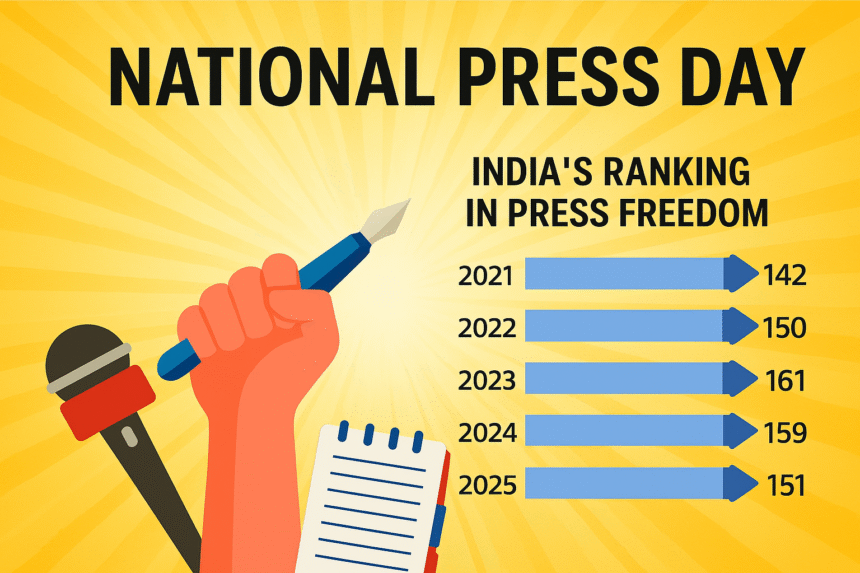
This issue aligns with the broader challenges seen in India’s position on the 2025 World Press Freedom Index, where the country ranks 151 out of 180. The ranking points to constraints faced by journalists, pressures on independent reporting, and the increasing complexity of operating freely and safely. These concerns are reflected in Tripura as well, where the deaths of several journalists in recent years have brought attention to the risks professionals face while carrying out their duties. Additionally, disputes among media figures at the state level, particularly within Kokborok news channels, have further highlighted concerns. The recent incident involving Pranab Sarkar, editor and proprietor of Headline Tripura Nation, who circulated an incorrect report regarding the origin of Tipra Motha’s MLA Ranjit Debbarma, reflects the declining standards of verification and responsibility in regional journalism.
As National Press Day is observed through awards, annual reviews, and discussions on journalistic values, the larger context cannot be ignored. The press continues to be a key pillar of democracy, and its protection remains essential. Ensuring safety for journalists, maintaining ethical standards, verifying information before publication, and fostering neutrality are crucial for preserving public confidence.
The events of recent months and years emphasize the need for balanced reporting and responsible media conduct. The continued strengthening of institutional frameworks, along with adherence to established journalistic principles, is necessary to safeguard the credibility of the press. As the situation evolves, the focus must remain on upholding integrity and ensuring that the fourth pillar of democracy remains stable, independent, and prepared to meet the expectations of the future.